
Seeing Through Stigma with Eddie
Culminating Mental Health Awareness Month, Aspire House hosted a bagel buffet and heard from members, who shared their stories as a part of panel discussion in Heart & Soul’s “Seeing Through Stigma” program. Eddie, an Aspire House member, shared these remarks as a panel participant.
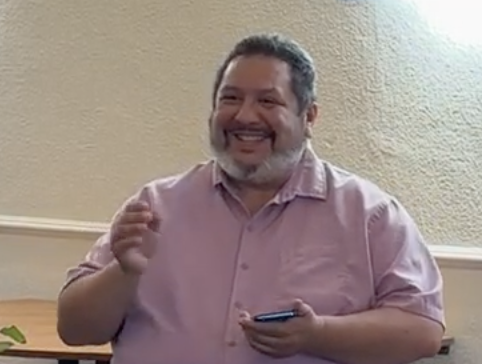
Stigma is a mark of disgrace. A negative label attached to a person, a circumstance, a quality. And today, I want to talk about removing that mark — at least a little bit — when it comes to mental health.
I’ve struggled with mental health challenges my whole life. When I was younger, I had nightmares a lot. I felt alone most of the time and didn’t really understand why. I was also a nerdy, geeky kid. I read the dictionary, the thesaurus, encyclopedias — for fun.
I was like a walking encyclopedia and Cliff Notes. People made fun of me for being too smart. I stuttered around girls as a teenager. I was friendly, but I felt awkward. I felt like I was never quite enough inside. And I was a people pleaser from early on
— always trying to make everyone comfortable while quietly feeling out of place.
What I want to say about that is this: it’s okay to be different. It’s okay to be unique. It’s okay to be exactly who you are. Don’t let that cause you anxiety. Be you — your full, authentic self. The world needs that, not a version of you performing for everyone else.
And I grew up in a culture where you simply did not talk about these things. If you brought it up, you were called loca — crazy. So you stayed quiet.
On top of that, I had a mother with manic depression and schizophrenia. I helped care for her. I helped care for my brother. And when I was 18 years old, my mother died by suicide. That profoundly changed my life.
The years after that were years of grief and depression. It affected my college years. It affected my academic performance. I was just trying to get through.
One of the hardest things grief taught me is that life goes on — with or without you. The world doesn’t stop. And you have to decide whether you’re going to move with it or get left behind. That lesson came the hard way.
I also learned the hard way not to use alcohol and drugs as a crutch. When you’re in pain, it’s tempting to escape. To numb it. But it doesn’t fix anything — it just delays it and often makes it worse. I had to face what I was struggling with, not run from it.
For me, the more traditional methods of dealing with mental health — medication, certain therapies — haven’t always worked. So I had to find my own way. Exercise. Walking. Meditation. Prayer. And writing. I started writing poetry at 18 years old, and I still write today. It’s one of the ways I let things out.
What I want to say clearly is this: the mental health journey is not linear. It is not easy. And it is not something you solve overnight. It takes years. It is a continual process. And that’s okay.
Programs like Aspire House, Heart and Soul, and Voices of Recovery have been big parts of my journey. Community matters. Finding people who actually understand and support you — that matters.
At Aspire House, they call me the Aspire Whisperer. I serve as a Member Lead there, and it’s been one of the most meaningful things in my life. I’ve enjoyed cooking for members, and I’ve gotten to work with the business unit on social media and as an editor.
Last year I had the opportunity to volunteer as staff for Heart & Soul. And recently I found transitional employment as admin support at the county — which is a big step forward. These aren’t just programs. They gave me purpose, community, and a place to grow.
I also want to be honest about the hard parts. Relationships have been tough for me. I’ve dealt with codependency. I have social anxiety. I deal with anxiety on and off. Some of my relationships have suffered because of my mental health challenges. I’ve been in a difficult on-and-off relationship that has also helped me grow — but it hasn’t been easy. I’m not going to sugarcoat any of that.
Codependency makes you want to constantly please others. You put everyone else first and lose yourself in the process. But you have to ultimately make yourself happy — not others. That’s not selfish. That’s survival.
And conflict is hard. Conflict resolution is hard — especially when you’re already dealing with so much inside. What I’ve learned is that sometimes the best way to handle anger and conflict is to just walk away from it. Not forever. But in that moment. Take a walk. Breathe. Come back when you’re ready. Walking away is not weakness — sometimes it’s the smartest thing you can do.
What I will say is this: you have to put your own oxygen mask on first. You have to take care of yourself. Be kind to yourself. And be kind to others — because kindness is genuinely underrated.
Love is the key to a lot of what we deal with. Love yourself. Love others. Love your family and friends. Love your community. Love God, or the universe, or whatever higher purpose you subscribe to. Keep loving. Keep being kind. Take it one day at a time.
And one more thing — because life is genuinely ridiculous sometimes. Being goofy, being silly, telling jokes, laughing — that has helped me too. Don’t underestimate it.
There is no easy solution. But keep striving. Keep working on yourself. Keep showing up for others. And keep moving forward — even when it’s hard, even when it’s slow, just keep moving forward.
All things work together for good. I believe that. Even the painful parts, even the years that felt like a loss — they shape you. They build you. They bring you to rooms like this one.
And I want you to know — I’m always here as a friend for anyone who is struggling. You don’t have to go through it alone. Reach out. Talk to someone. Let people in.
You are not alone.
If you’re interested in learning how to tell your story or would like to learn more about “Seeing Through Stigma,” contact Heart & Soul at info@heartandsoulinc.org or 650-232-7426.